The guide
A weaving draft is four small grids, and most arguments about them are about which way is up
Threading, tie-up and treadling are instructions; the drawdown is what follows from them. Reading a draft well means knowing which conventions its author assumed, and checking the cloth before the loom is warped.
- 5 shafts the fewest that can weave a true satin; six cannot weave one at all
- 1, 3, 5, 2, 4 ends caught on picks one to five of a five-shaft satin, step 2
- 4, 8, 8, 4 heddles per shaft for 24 ends of a four-shaft point twill
- 8 1/8 in width in the reed of 65 ends at 8 ends per inch
- WIF 1.1 the plain-text format most weaving programs exchange
Read the full guide Fold the guide
A weaving draft looks like a crossword that somebody abandoned. Four blocks of graph paper, some squares filled, no words anywhere. Yet a weaver can dress a loom from it, and can tell before a single thread is cut whether the cloth will hold together.
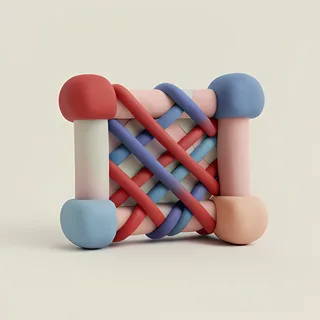
It manages this by keeping apart what the loom is and what the weaver does. One tutorial for new weavers counts four parts: the threading, the tie-up, the treadling and the drawdown. The first three are instructions. The fourth is a prediction, and it contains nothing that the other three did not already settle. Learning to read a draft is mostly learning to see that the big picture in the middle is arithmetic done on the three small grids around it.
Four grids, one cloth
The threading is the strip that runs across the page. Each column is one warp end and each row is one shaft, so a filled square says that this end passes through a heddle on that shaft. A loom maker’s guide points out that the threading is always drawn horizontally, as though you were looking at the shafts from the front of the loom.
The treadling runs down the page. Each row is one pick, a single pass of the weft, and each column is a treadle. Where the two strips meet sits the tie-up, a small square that says which shafts each treadle moves. On a table loom, where every lever works one shaft, tie-up and treadling fold into a single grid called a lift plan, with a column for each shaft and a row for each pick. The same guide describes a lift plan as redrawing and combining the other two.
The drawdown fills the rectangle that is left. Take any cell in it. Look along its column to find which shaft that end is threaded on, look along its row to find which treadle that pick uses, and ask the tie-up whether that treadle moves that shaft. If the shaft is lifted, the warp end lies on top of the weft at that crossing. If not, the weft covers it. A university computing newsletter that ran a long series on weaving put the usual picture in one line: a drawdown uses black for the warp threads and white for the weft threads. That is the whole machine. Three small grids multiply into a large one.
Which way is up
The trouble begins when two drafts for the same cloth do not look alike. Most North American drafts put the threading at the top and read it from right to left, with shaft one on the bottom row, nearest the weaver. The treadling is read from the top down. Swedish drafts put the threading and the tie-up at the bottom of the page instead, because they are read as if you were sitting at the loom. One loom maker has published treadlings that read from the bottom up, with an arrow, because that is how fabric grows on the loom.
These are differences of layout. Turn the page over in your head and the cloth is the same cloth. The shed is another matter. On a jack loom or a table loom, pressing a treadle raises the shafts tied to it, and such looms are called rising shed looms. On counterbalance and countermarche looms the working shafts go down. A filled square in the tie-up therefore means opposite things on the two kinds of loom. Read a draft with the wrong assumption and every crossing inverts, so that the warp shows wherever the weft was meant to.
What you get is the same cloth woven face down. A weaving tutorial describes the experience exactly: a tie-up written for a counterbalance loom raises the wrong threads on a jack loom, and you can either tie up the white squares instead of the black ones or simply carry on, since the right side is hidden underneath. On a balanced twill the diagonal may just run the other way. On a structure with a definite face the difference matters.
There is history in this. Drafts were first written for sinking sheds, and magazines began marking tie-ups for rising sheds only after jack and table looms became popular in the United States. The loom maker’s advice is blunt: a book from Europe, or from before the 1930s, probably assumes a sinking shed; crosses in a tie-up usually mean sinking and circles rising; software that offers no choice probably prints for rising sheds. Whenever possible, check the source.
Three ways to cross two threads
Plain weave is the simplest answer to how a warp and a weft can hold each other. A cotton industry encyclopedia defines it in two sentences: it repeats on two ends and two picks, each end weaves one pick up and one pick down, and each adjacent end weaves opposite the other. The university newsletter calls this strict one-over, one-under interlacing the strongest there is. Let two or more yarns travel together as if they were one and you have basket weave.
Twill loosens the grip by letting threads pass over two or more at a time, and it shifts that pattern by one square on each successive row of the tie-up, which is what draws the diagonal. Twills are named by fractions. A 2/1 twill is read two up, one down, and the numbers add up to the shafts required, so a 2/2 twill needs four. Thread the shafts in order and the diagonal runs straight. Reverse the order after at least three threads and the line zigzags into a point twill. Skip a shaft and the line breaks.
Satin goes further. It allows each shaft only one interlacement in the repeat and scatters those points so that no two are neighbours on successive picks. The scattering is done with a step, also called a counter, and the rule for choosing it is strict. It cannot be one, or the points line up as a twill. It cannot be one fewer than the number of shafts, or they line up as a twill in the other direction. It cannot share a divisor with the number of shafts, or some threads interlace more than once and others never.
The consequences are curious. A satin needs at least 5 shafts, and no satin can be woven on six, because every candidate step fails one of the tests. On five shafts a step of 2 works: the single interlacement of picks one to five falls on ends 1, 3, 5, 2, 4. Between those points each thread travels past four others without touching down.
Those unbound stretches are floats, and the whole progression from plain weave to satin exists to make them longer. A float is a thread passing over or under more than one thread of the other set. Floats give satin its smooth surface and its drape. They also reduce strength, and they snag.
Checking before the warp is wound
All of this can be worked out on paper before any yarn is measured, and a small example shows how much a draft already knows. Take four shafts and thread 24 ends as a point: 1, 2, 3, 4, 3, 2, repeated four times. Tie four treadles to shafts 1 and 2, 2 and 3, 3 and 4, 4 and 1, and treadle them in order for 24 picks.
Count the threading and the heddles per shaft come to 4, 8, 8, 4, because the two turning shafts are visited once in each repeat and the two middle shafts twice. Follow the drawdown and no warp end floats over more than two picks, while the weft floats over three ends wherever the threading turns. Every end and every pick interlaces. At 20 ends per inch the warp is 1.2 inches wide in the reed. None of that required a loom.
The check that matters most is the one for threads that never interlace at all. The newsletter shows a draft in which some weft threads float all the way across the fabric, and notes that they would not be attached to it: the draft is unweavable. A related trap is the float that only appears when the pattern repeats. When a draft shows one repeat of a pattern, a float that runs off its right edge continues from its left, and has to be counted around the corner.
Color needs a second look, because the pattern a viewer sees is not always the structure. In color-and-weave effects, light and dark threads alternate in both warp and weft so that the color order, not the interlacement, makes the picture. Log cabin is plain weave with two alternating colors, and its lines turn from vertical to horizontal wherever two threads of the same color sit side by side. Four dark and four light threads on a 2/2 twill give houndstooth. A drawdown should be readable both ways, as structure and as color.
The last piece of arithmetic is the sett. One published scarf has 65 warp ends at 8 ends per inch, and so measures 8 1/8 in across in the reed. Ends divided by ends per inch: nothing more.
What the grid cannot tell you
That figure is the width in the reed, not the width of the scarf. Some of every warp is lost to take-up, some to shrinkage and some to loom waste. The same pattern asks for an 84 inch warp to make a 54 inch scarf, a figure that folds all three together. Those allowances change with the yarn and with the finishing. No grid contains them, and an honest draft program either leaves them out or asks weavers for their own numbers.
Nor is a drawdown a photograph. It records which thread is on top at each crossing and says nothing about how yarns flatten, slide or bloom. The newsletter that explained floats also remarked that realistic rendering of a fabric surface is in another class altogether. A three-dimensional view of the interlacement is useful for seeing structure. It is still a diagram.
Drafts travel between weavers in a format built for exactly that. The Weaving Information File, WIF 1.1 in the national archive registry that catalogues it, is plain text modelled on the .ini settings file, with named sections holding lists of keywords and values. It was developed jointly by the programmers of several weaving programs so that a draft made in one could be opened in another, and it can be read in a text editor. It is also used to drive computer-assisted dobby looms. It is verbose and it is only raw data, but most weaving software reads it.
A draft, in the end, is a compact promise about cloth, and promises depend on shared assumptions. The most useful habit a draft can have is to state its own: which shed, which way the threading reads, where pick one is. Then the grids can be trusted to do what they have always done, which is to let a weaver see the fabric before the warp is on the beam.
Sources
Every source consulted for this guide. Links checked October 5, 2026.
- How to Read a Weaving Draft Gist Yarn
- What is a weaving draft and how do I use it? Schacht Spindle Company
- What is a float? What is a weaving mistake? Schacht Spindle Company
- Weaving a Twill Sampler - Part 2 Schacht Spindle Company
- Simple Math for Weavers Schacht Spindle Company
- Color-and-Weave vs. Shadow Weave: Part One Gist Yarn
- Getting Started with Log Cabin Weaving: Simple Techniques for Stunning Results Gist Yarn
- The Icon Analyst, Number 59 (Floats; Satin; Tie-Ups) University of Arizona, Department of Computer Science
- The Icon Analyst, Number 58 (Twills) University of Arizona, Department of Computer Science
- The Icon Analyst, Number 56 (Drawdowns) University of Arizona, Department of Computer Science
- The Icon Analyst, Number 53 (Weaving Drafts) University of Arizona, Department of Computer Science
- Weaving Information File (WIF) The National Archives, PRONOM
- FAQs for WIF Files Long Thread Media
- Plain Weave CottonWorks, Cotton Incorporated
- Basket Weave CottonWorks, Cotton Incorporated
- 2 x 2 Broken Twill CottonWorks, Cotton Incorporated
- Twill - Wikipedia Wikipedia