
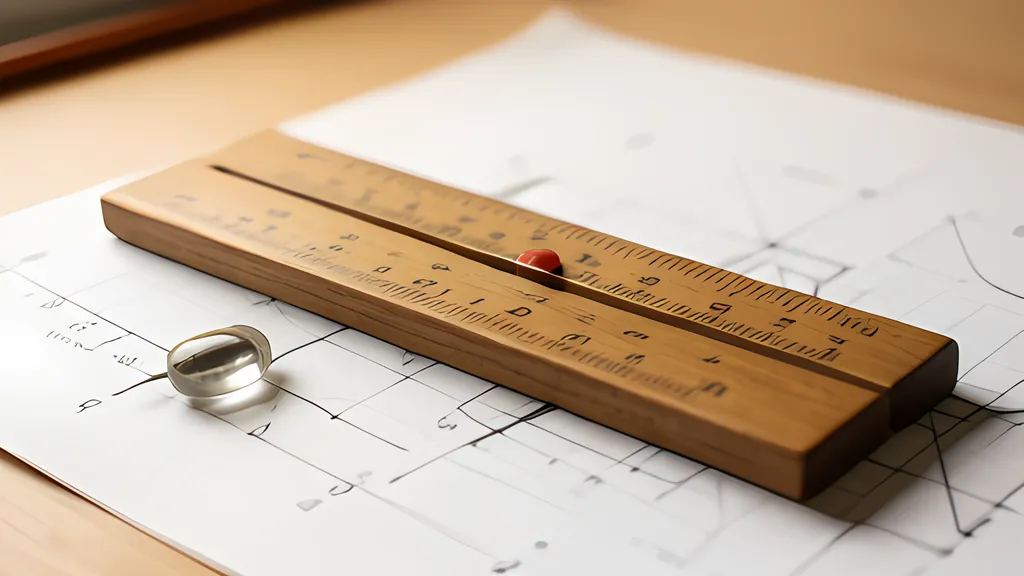
The guide
A Slide Rule Multiplies by Adding Two Lengths, and Three Figures Was Enough to Build a Century
Two strips marked with logarithms turn multiplication into sliding. How the scales work, why the answer comes without a decimal point, and why the instrument vanished in a few years.
- 1614 Napier publishes his logarithms
- about 1622 Oughtred slides two logarithmic scales, by one account
- three figures what a standard rule reliably gives
- 225.8 mm where 8 sits after 2.5 x 3.2 on a 250 mm scale
- 1972 the first handheld scientific calculator arrives
Read the full guide Fold the guide
A slide rule does not know any arithmetic. It is two strips of numbered marks that slide past each other and a hairline to compare them. Everything it does follows from one decision about where the marks go: each number is placed at a distance equal to its logarithm. Put two such strips end to end and their lengths add. Since adding logarithms is the same as multiplying the numbers, the far end of the second length points at the product.
That one idea carried engineering for about three hundred and fifty years. It also set the instrument’s character. A slide rule gives digits without a decimal point, it gives about three of them, and it expects the person holding it to know roughly what the answer should be. Those are not defects that better manufacturing would have removed. They are what a length can tell you.
From a table to a line to two lines
The logarithm came first. John Napier published his in 1614, saying in his preface that nothing troubled calculators more than long multiplications, divisions and root extractions. His own numbers were awkward, because the logarithm of 1 was not zero. Henry Briggs, who travelled to Edinburgh to meet him, agreed with Napier on logarithms to base 10 with the logarithm of 1 set to zero, and published his first work on them in 1617.
A table still has to be read and added on paper. In 1620 Edmund Gunter drew the table instead: a logarithmic scale along a two foot ruler. To multiply, a navigator set a pair of dividers to the distance from 1 to the first number and stepped that distance on from the second. The MacTutor biography notes that seamen simply called the rule a gunter, and counts it an important step toward the slide rule.
William Oughtred removed the dividers by laying two of Gunter’s scales against each other and sliding one. When he did it is less settled than popular accounts suggest. The Oughtred Society, named for him, says about 1622. The International Slide Rule Museum’s timeline says 1630. The MacTutor biography gives 1630 for a circular form and 1632 for the two straight rulers, the year his description appeared in print. A former pupil, Richard Delamain, published a circular instrument in 1630, and the two men argued bitterly over priority.
The argument was partly about teaching. Oughtred distrusted instruments used without understanding, and the MacTutor biography quotes his warning that “the true way of Art is not by Instruments, but by Demonstration.” It is a fair standard to hold a slide rule to, because the instrument rewards exactly the understanding he wanted.
The familiar layout is much later. Around 1850 a French artillery officer, Amedee Mannheim, settled on four scales labelled A, B, C and D and helped make the sliding cursor a standard part. Folded scales followed about 1900, and rules with scales on both faces were patented in the early 1890s. The Oughtred Society reports an estimate of perhaps 40 million slide rules made in the twentieth century alone.
Why sliding multiplies
Take a scale 250 mm long that runs from 1 to 10. The number 2.5 sits at the logarithm of 2.5, which is 0.39794 of the length, or 99.5 mm from the left end. The number 3.2 sits at 0.50515 of the length, 126.3 mm along. A second, identical scale on the slide lets you lay the second distance after the first. Slide its left end, the index, over 2.5 on the fixed scale. Now 3.2 on the slide is 99.5 plus 126.3 mm from the start: 225.8 mm. The number engraved at 225.8 mm is 8. The rule has multiplied 2.5 by 3.2 without doing anything but adding.
Division is the same picture run backwards. Bring the divisor on the slide over the dividend on the body and the index points at the quotient, because one length has been subtracted from the other.
The scheme breaks in one place, and the fix is instructive. Try 2.3 times 4.5. The lengths are 90.4 mm and 163.3 mm, which add to 253.7 mm, and that is 3.7 mm past the end of a 250 mm scale. Nothing is lost. A whole scale length stands for a factor of ten, so sliding the right-hand index over 2.3 instead shifts everything back by exactly one length, and 4.5 now sits over 1.035. The digits are right. Only the power of ten has changed, and the rule never showed that anyway.
So the decimal point is the user’s job. The standard method is the one the museum’s course teaches: round the numbers and estimate. Two times five is ten, so 1.035 must mean 10.35. For harder cases write each number in scientific notation, let the rule supply the digits, add the exponents by hand and adjust by one if the estimate says so. People who learned this way were rarely wrong by a factor of ten, because they had already guessed the answer before reading it.
What the other scales are for
Every further scale is the same trick with a different function drawn on the strip. The C scale on the slide and the D scale on the body are the pair described above. CI is C running backwards, so the hairline shows a number and its reciprocal together. CF and DF are C and D started at pi rather than 1, which multiplies by pi with no setting at all and gives a second chance when a factor falls off the end of D.
A and B squeeze two decades into the same length, so a number on D sits under its square on A. K holds three decades and gives cubes. Reading these backwards gives roots, with one catch: you must choose the correct half of A. The square root of 450 is found on the left half and is 21.2, while the square root of 4500 is found on the right half and is 67.1. The rule of thumb counts digits. An odd count before the decimal point uses the left half and an even count the right.
L is the odd one out. It is an ordinary evenly divided ruler, so it shows how far along D the hairline is, which is the logarithm itself. The log of 3 reads 0.4771. S and T carry angles placed at the logarithm of their sine or tangent, covering about 5.7 to 90 degrees and 5.7 to 45 degrees, and a small-angle scale handles 0.57 to 5.7 degrees, where a sine, a tangent and the angle in radians are nearly the same number.
Three figures, and then none
How good is the answer? The marks on a standard rule take you to two figures and the eye estimates the third between them; collectors’ guides put a full-length rule at three to four significant figures. The geometry agrees. On a 250 mm scale a slip of 0.1 mm in setting or reading changes the value by about 0.09 percent wherever it happens, and every multiplication involves three such settings. The instrument honestly holds three figures.
That was enough. One collector’s guide says plainly that for most real-world applications this precision is usually more than sufficient, and the Oughtred Society credits the instrument with the design calculations behind virtually every major structure built while it was in use. Where more was needed, makers lengthened the scale. Edwin Thacher’s cylindrical rule of 1881 carried a much longer scale than a straight rule and could give four to five figures.
There are things the method cannot do at all. It cannot add or subtract, since sliding logarithms only multiplies. It cannot hold an exact integer result of many digits, such as a payroll total. It has no zero and no negative numbers on its main scales. And its accuracy is only as good as the engraving and the user’s eye.
The end came quickly. Crews still carried a five inch rule on Apollo flights. A Smithsonian catalogue record describes the model, a yellow aluminum Pickett with scales on both faces and a case that clips to a pocket or a belt, and the one taken along on Apollo 13 in April 1970 is now in the National Air and Space Museum.
Then, in 1972, Hewlett-Packard introduced the HP-35, the first pocket calculator with trigonometric and exponential functions. It showed ten digits and placed the decimal point itself, switching to scientific notation when a number called for it. Until then a slide rule had been the only practical portable device for such functions. Belt holsters for slide rules soon gave way to holsters for what people called electronic slide rules. Cheaper scientific calculators followed within a few years, and the International Slide Rule Museum’s timeline records the last rule from one great American maker going to the Smithsonian in 1976.
What disappeared with it was a habit more than a tool: estimating first, and treating the third figure as something you are not quite sure of.
Making one from paper
A working rule needs nothing but accurate marks, which is why magazines once printed them to cut out, and why the museum keeps printable scales. The paper rule from this page is a sleeve: the body’s two flaps fold back around a slide strip, and a band with a hairline wraps around both. Print it at actual size and check the ruler on the sheet before cutting, because a printer that scales the page by two percent leaves each scale consistent with itself but spoils the fit of the sleeve. Card works better than thin paper. Then set the index over 2.5, find 3.2 on the slide, and read the 8 for yourself.
Sources
Every source consulted for this guide. Links checked October 6, 2026.
- Oughtred Society Slide Rule History. The Oughtred Society
- Illustrated Self-Guided Course On How To Use The Slide Rule International Slide Rule Museum
- Slide Rule Scales International Slide Rule Museum
- Eric's Types of Slide Rules and their Scales Eric Marcotte, Eric's Slide Rule Site
- Eric's Introduction to the Slide Rule page Eric Marcotte, Eric's Slide Rule Site
- William Oughtred (1574 - 1660) - Biography MacTutor History of Mathematics, University of St Andrews
- Edmund Gunter (1581 - 1626) - Biography MacTutor History of Mathematics, University of St Andrews
- John Napier (1550 - 1617) - Biography MacTutor History of Mathematics, University of St Andrews
- Henry Briggs (1561 - 1630) - Biography MacTutor History of Mathematics, University of St Andrews
- Pickett N600-ES Log Log Duplex Slide Rule National Museum of American History, Smithsonian Institution (open access record, CC0; archived copy at the Internet Archive)
- Apollo 13 Wikipedia
- Slide rule Wikipedia
- Slide rule scale Wikipedia
- HP-35 - Wikipedia Wikipedia