Color Theory for People Who Failed Art Class
You don't need an art degree to pick colors that don't fight each other. The cheat codes to color theory, explained without pretension.
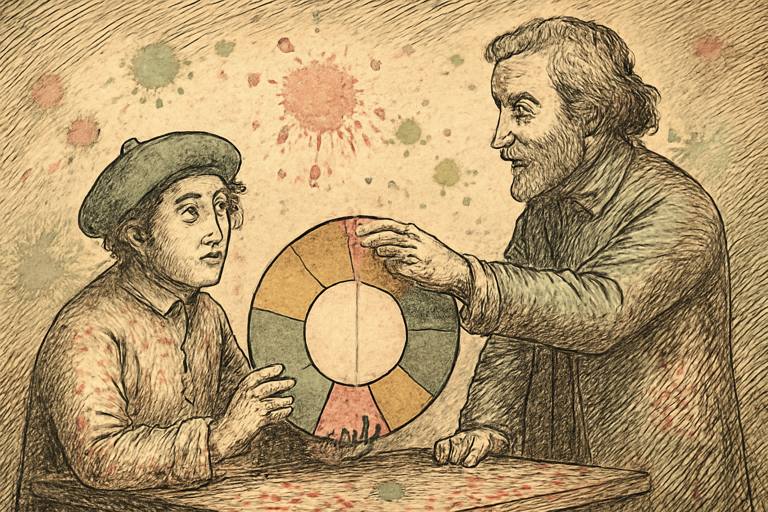
You’re building something. A website, a presentation, a poster for your band that definitely has potential. You need to pick colors. You stare at the color wheel. The color wheel stares back. You panic and pick blue because blue is safe.
This is the guide for you.
The Only Three Things You Need to Know
1. Complementary colors pop. Colors opposite each other on the color wheel create maximum contrast. Blue and orange. Purple and yellow. Red and green (careful with that one, it’s very Christmas). Use these when you want something to stand OUT.
2. Analogous colors chill. Colors next to each other on the wheel create harmony. Blue, blue-green, and green feel calm together. Use these when you want something to feel cohesive and not give people a headache.
3. 60-30-10 rule. Use your main color for 60% of the design, a secondary color for 30%, and an accent for 10%. This ratio works for everything from websites to outfits to room decor. It’s basically a cheat code.
The Cheat Codes
Don’t want to learn color theory? Fine. Here are the shortcuts:
- Color palette generator: Pick one color you like. It generates 4-5 colors that work with it. Done.
- Color picker: See a color you like somewhere? Use the picker to grab its exact hex code.
- Brand color system generator: Input your one brand color, get an entire system: light and dark shades, text colors, background colors, the works.
Colors and Feelings (It’s Not Woo-Woo, It’s Science)
Colors trigger associations. Not magical energy, just cultural and biological patterns:
- Blue: Trust, calm, reliability. That’s why every bank and tech company uses it. It’s the Toyota Camry of colors.
- Red: Urgency, energy, passion. Sale signs, stop signs, notification badges. Red says “look at me NOW.”
- Green: Growth, health, money. Every environmental org and financial app lives here.
- Yellow/Orange: Fun, warmth, creativity. Approachable but can feel cheap if overused.
- Purple: Premium, creative, unconventional. It’s the “I’m different” color.
- Black: Luxury, elegance, power. Every premium brand eventually goes black.
The Accessibility Part (Don’t Skip This)
8% of men and 0.5% of women have some form of color blindness. If your “click the red button” instruction looks the same as the green button to them, you’ve lost users.
Check your palette with a color blindness simulator. And always verify your text-to-background combos meet WCAG standards using a contrast checker. If it passes, everyone can read it. If it doesn’t, it doesn’t matter how pretty it looks.
The Fastest Way to Not Mess Up Colors
- Start with ONE color you like
- Generate a palette from it
- Apply the 60-30-10 rule
- Check contrast ratios
- Simulate color blindness
- Ship it
You don’t need an art degree. You need a system. Now you have one.